 Hassanain, Ola, and Chandra Frank. “Tell the water what the clay kept secret.” Global Performance Studies, vol. 7, no. 1, 2024, https://doi.org/10.33303/gpsv7n1a231
Ola Hassanain in conversation with Chandra Frank
Ola Hassanain’s artistic research has led to a practice centred on the concept of ‘space as discourse’, which cultivates strategies and analysis to reflect on how power becomes visible—and felt—through built environments. Her practice engages with places shaped by climate instability, postcolonial legacies, and displacement, thinking through the politics of inhabiting and how ecological and social systems shape one another across time.
Departing from a long-standing project of four scripts, titled Tell the water what the clay kept secret (2023—), this work imagines the spatial implications of catastrophe. Conceptualized via a practice of space-making, Hassanain interrogates ecologies of inhabitation. The project explores the enduring impact of the Gezira Agricultural Scheme in Sudan, a 4.300-kilometer (2670 mile) network of canals and ditches, which irrigate the fields. The area is well known for its agricultural produce; however, the scheme has led to ecological dilemmas that threaten inhabitation. The mismanagement of the irrigation scheme has jeopardized the soil in many areas.
Each iteration of Tell the water what the clay kept secret reflects a distinct cycle of catastrophe: Whispers, Watching, and Arrivals. These three scripts are informed by the archipelagos of spatiotemporal realities. These scripts anchor the research in a particular geography identified by the artist as a site of catastrophe.
Hilat Mostafa Gorashi: حلة مصطفي قرشي.
14.803240767818515, 33.240297782211115
Could you tell us more about how your current project, Tell the water what the clay kept secret, and how you understand ‘space as discourse’?
The phrase “Tell the water what the clay kept secret” refers to the relationship between water and clay in the context of my grandmother’s house. Exploring the spatial implications of catastrophe, I hone in on the temporal material constellations that underlie the water seeping into the clay soil, which manifest as cracks and a slow disintegration of the house. We don’t necessarily see this happening in ‘real’ or linear time, so we need different registers to monitor and articulate the cracks.
In so doing, we can get our bearings to transmit ecologically relevant information about the shifts and changes in our material environment–both man-made and otherwise due to onsets of catastrophe. Really, it is an attempt to start talking about how catastrophe creates new material environments, and how, in turn, these environments adopt new symptoms of the catastrophe.
This is usually a very slow unearthing, which is why the project comes into being via different scripts to account for broader understandings of space. As research-led practice, space here also becomes understood as discourse. The more weaving and slow unearthing we do, the more we are building a nuanced spatial literacy. This literacy developed is hyper-aware of the condition under which it’s being produced, so it doesn’t pass on the information as given. It accepts the same rate of material shifts and changes alongside catastrophe.
How does your artistic research practice invite us to rethink the role of architecture as it pertains to habitability? And how do you understand the relationship between catastrophe and architecture?
Understanding architecture as a political discourse is central to my practice. It is the biggest political project ever. It gets to hide behind the performativity of politics because we do not centre the spatial imprint of hegemony in architecture. This is why spatial literacy is crucial if we want to understand how we inhabit the world. We also need spatial literacy to imagine how it can be done otherwise.
I find architecture fascinating. Architecture acts like a vessel, it gets to be invisible and innocent because it is stationary and blends as the background to our daily lives. I desire a reality where people have a baseline of spatial literacy or architectural education, because I think it is a main political tool. In Sudan, our cities are militarised and function as the infrastructural basin of profitable brutality. I do not propose a one-way demand to learn spatial vocabulary, but to open up the other side of the gate for the very spatial knowledge that is not reflected in the current political project. In moments where I speculate like this, I make people realize that my grandmother’s efforts to maintain the house against its looming collapse was a spatial intervention. Meaning, I am talking about architecture and our built environment when I speak about my grandmother’s house.
When I think of the type of architecture education I got through the years, I realize that I was working with a creative regime completely detached from the spatial realities of inhabiting that I was experiencing. Architectural knowledge is structured on ideas of permanence. Here, we see how cultural reinforcement[1] underlies modernist architecture. In other words, architecture based on ideas of permanence reflects western hegemony as an aesthetics of continuation. Meaning that the structures of permanence are continuously reproduced without accounting for the violent ideologies that made way for this hegemony to exist. So, if we centre habitability, then we can enable other political ecologies of existence in the world that will challenge hegemony.
If we were to follow Sylvia Wynter’s conceptualization of The Human, we can understand how architecture is brutal precisely because it situates habitability as the main frame. Yet, it only gives access to a particular category of human, which Wynter (2003) describes as the transition of Man I to Man II, which then becomes the sole political subject and readable subject in the world. It reminds me of a quote of Frantz Fanon’s The Wretched of the Earth, “Leave this Europe where they are never done talking of Man, yet murder men everywhere they find them” (Fanon [1961] 1963, 9).
When I think of anti-profitable brutalities, I always think of people and space outside of property lines. There is an inherent dislocation of today’s premise of ownership, or being part of a community or society built on ownership. For example, ‘brutalist’ architecture. There is an irony in brutalist architecture because it is characterized as a responsible response to the need for affordable buildings, such as social housing. Yet, it embodies the utilitarianism of aesthetics and is completely focused on the form of the building. I always think of the emergence of aesthetics alongside forms that respond to community needs. We might ask: what is the need to inhabit? My larger point then is about allowing for collective spatial sensibilities to inform the form and spatial organization of habitat.
How do these notions of space and catastrophe translate into the scripts you are working with?
Catastrophe is cyclical in that people become stuck in cycles of endurance and waiting until the conditions might change. People are always forced out of the environment. In Sudan, it’s a mechanism to ensure that people who live a certain way can never exist again. Catastrophe then, is coupled with control and destruction. Catastrophe turns our attention to the uninhabitable, which is my point of departure. If we were to define catastrophe, it would be the perpetual state of uninhabitability.
It is important to make clear that despite the conditions of inhabitability, there was life lived. I work with catastrophe not to erase existing ecologies, but to draw upon the tensions that arise as populations adopt and perform against the thresholds of impossibility. My work then reveals the traces of habitation in my grandmother’s house, which results in a cartographising of scenes, such as the companionship with water. For example, the recollections and remembrances of wetness, patches in the clay soil, the rust of metal cabinets from moisture, stains of hibiscus leaves, and other plants in the vicinity of the house. Together, these scenes form a score of material dialogue of habitability. It became generative to look at the time frame, starting from the water seeping into the soil–soaking and staining–to the moment it dries up and results in cracks.

A photograph taken by my cousin Rayan Osama. Courtesy of the artist’s family WhatsApp chat.
Water and clay hold temporal qualities, and their relationship tells us something about organic uses of the land, rather than industrial practices. Water and clay hold an alternative narrative to this spatio-political family history. One might approach the cracks in the clay as evidence of a fractured system. The cracks weaved themselves through all the house's surfaces, quite literally, “the cracks ran through our lives”.
Since the Gezira Scheme’s inception in the 1920s, water mismanagement persisted, which affirmed how architectures of water control in the area reconfigured the water as part of a system of damage. This happened amidst the tumult of state violence paired with a lack of desilting, which jeopardized the soil in many areas. My grandmother’s house lays on a compromised plot of the soil, cracks weaving down from the top of the house throughout the walls of the home, carving into the soil. Over the past decades, the house has begun to crumble. As I share this with you all, the house is now rubble.
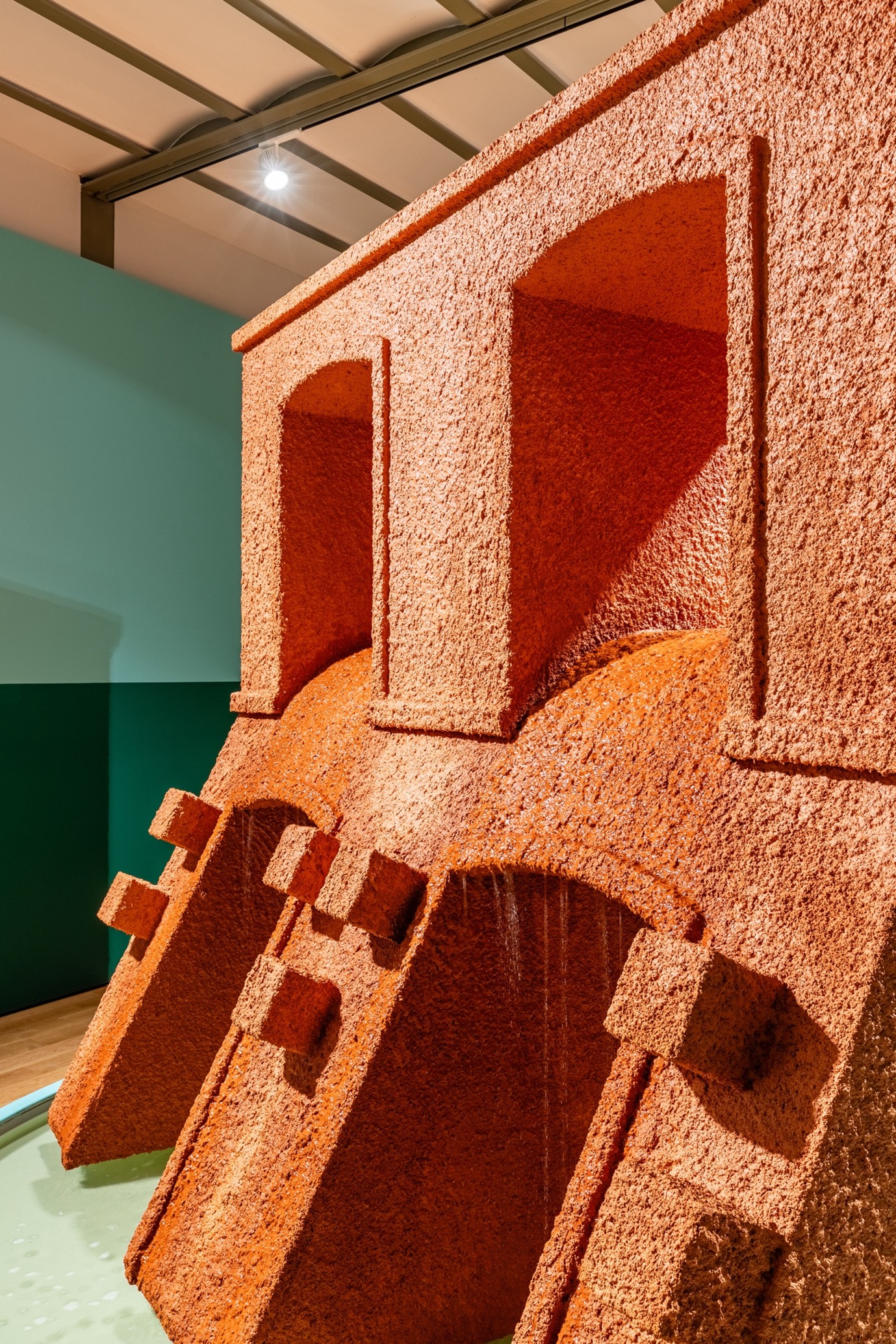
Ola Hassanain, A Whispering Dam (2024). Courtesy of the artist.
This shaped the making of the work A Whispering Dam (2024), which stands at 2.20 meters (7.2 feet) high as a relic of modernity. The whispers act as a filter for the water, allowing for the ritual of Ruqya (رقية) to rid it of its implications in the continuity of uninhabitability. I combine the political undertones of my grandmother’s aspirations to watch the cracks with ritual as a gesture for dislocating the water from a continuation of violence. For me, this mixed media installation marks the beginning of an anthology of what it means to inhabit cyclic natures of catastrophe.
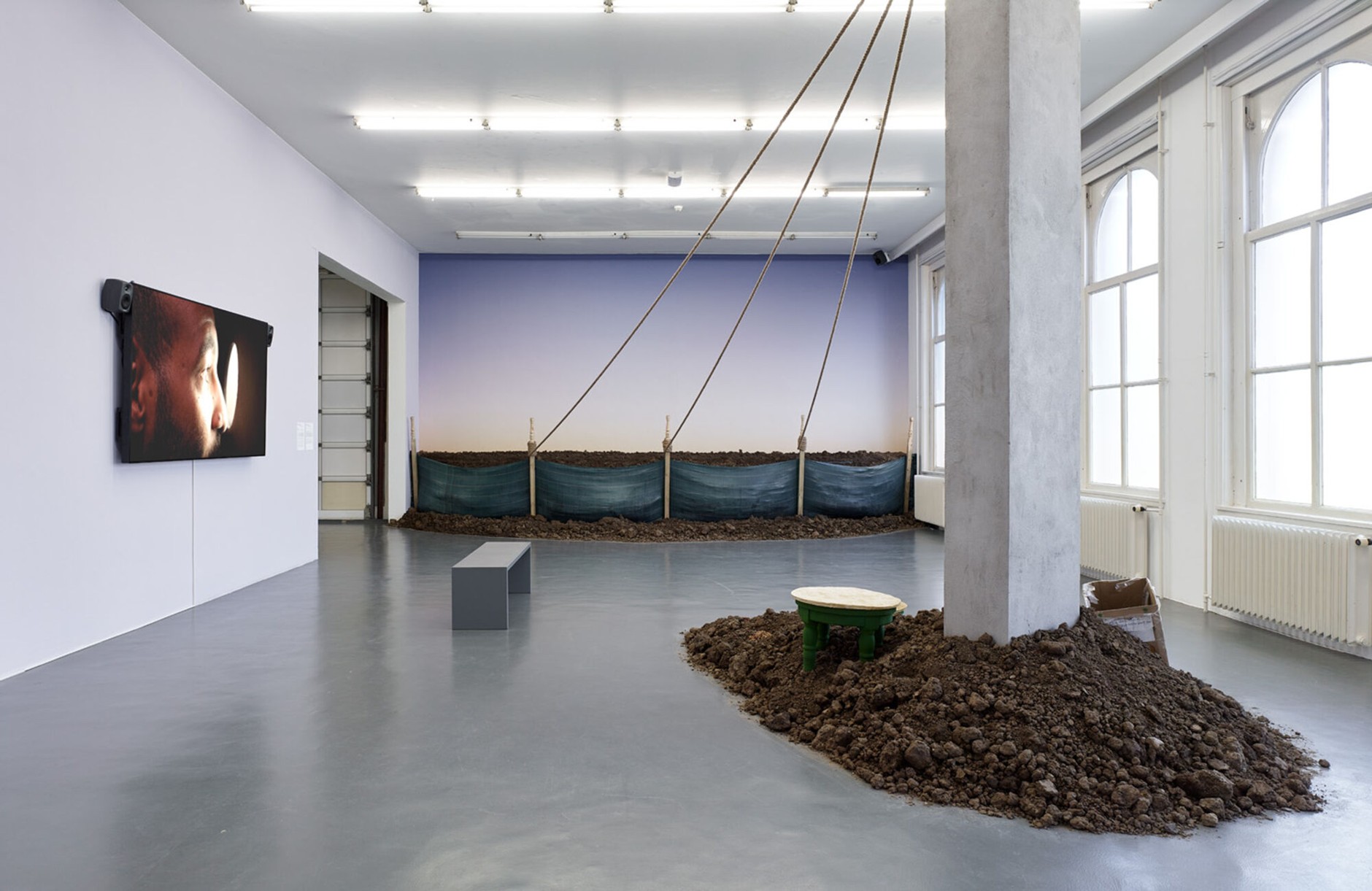
Ola Hassanain, The Watcher (2025). Courtesy of the artist. Photo credit: Kirstien Daem.

Hand sketch, representing the cycle of catastrophe. Courtesy of the artist.
The Watcher is just a name—it’s a particular activity, which happens within agricultural communities in general, where people take on the responsibility of watching their environment. The watcher, a community caretaker, monitors the water levels and signals potential flooding. The script of the watcher shows how humans and non-humans are entangled and complicit in making, and simultaneously surviving, resisting, and countering ecological catastrophes.
In the video installation, The Watcher (edition I of III), there are two characters played by the same performer. I contextualize the act of watching in both the informal settlements in Khartoum state (est. 1978) and in the Gezira Scheme (est. 1922). And then I also situate the character of The Watcher in the ‘Waterloopbos’ in the Netherlands, a former hydrological testing site. Both characters watch for the catastrophe of modernity, which brings a continuous cycle of removal and arrival. Within the agricultural landscape, the watcher observes for signs of ecological crisis and debris of ecological catastrophe, such as mud, storm surges, and floods that enforce departure due to uninhabitability. The same figure also inhabits his “historic future” in Waterloopbos, where control technologies were first tested, and then how these technologies were exported into colonial projects, such as the Gezira scheme. Watching becomes a way of reading this residue—it is a form of resistance, a practice of staying with what remains.
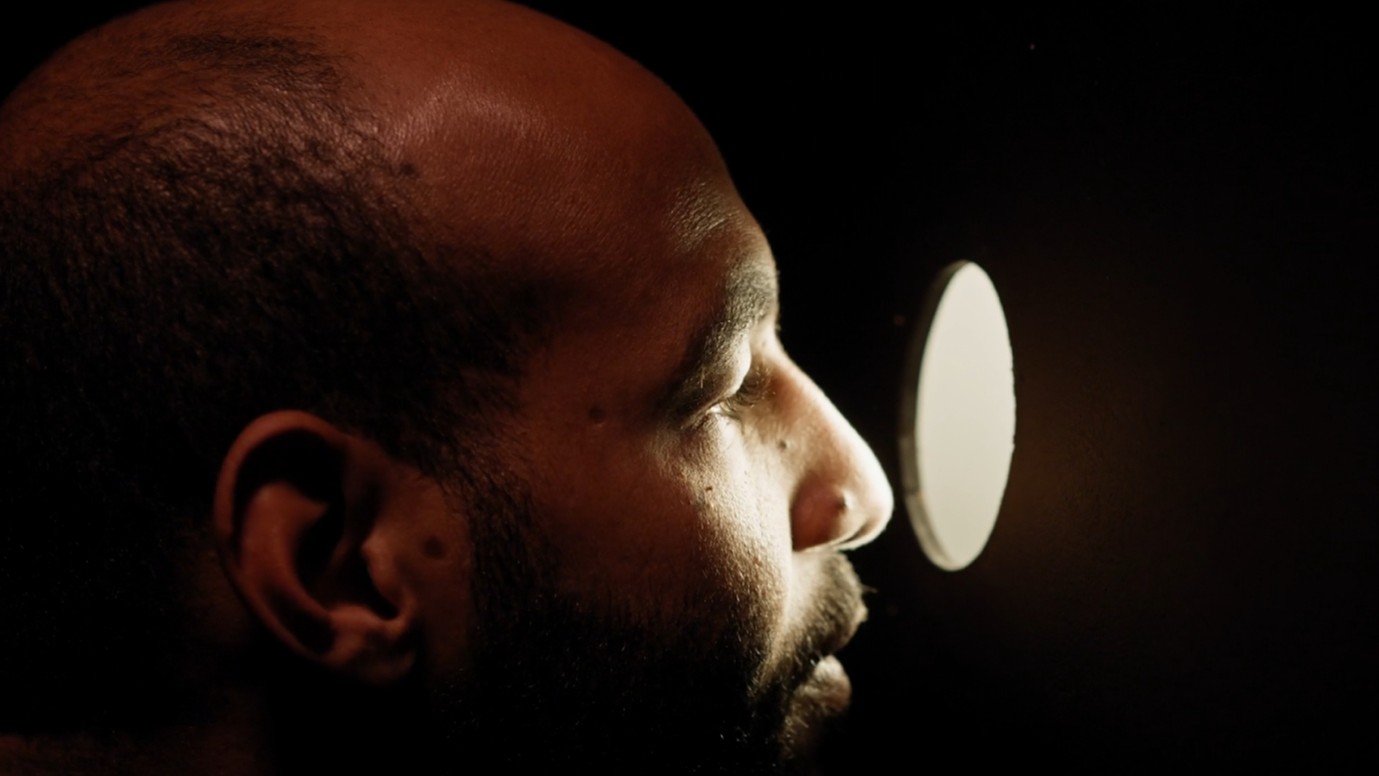
Ola Hassanain, The Watcher (2025), 19:16 mins, edition I of II.
For me, arrivals are movements and journeys—experiences shaped by larger forces and the desire to open new possibilities. The idea of arrival is seen as an ongoing condition, a lingering debris of modernity. It reflects the fragmentation of liveable space and the disruption of what it means to inhabit a place. Our bodies, too, carry the marks of modernity. When we arrive at so-called 'global centres,' we come altered—we bring with us memories of past ways of living, along with new sensibilities, ideas, and hopes for a different political ecology.
Following displacement, people find themselves in a state of perpetual arrival—entering new, complex environments that may never fully accept them. This condition reveals the profound limits that ecological disaster places on human experience and belonging. Many of us have both witnessed and experienced the widespread loss of habitat driven by expanding urban areas. This transformation has given rise to new patterns of migration, along with the movement of knowledge and ideas. At the same time, we often recognise the growth of our own practices as mirroring the territorial expansion of inherited imperial ideologies. We remain alert to the catastrophe of modernity—a relentless cycle of removal and arrival. Debris, both material and metaphorical, becomes a symbol of the residue left behind by systems, histories, and cycles that displace and erode.
The work Arrivals from Elsewhere (2025), is a set of hand-formed door handles, which traces the gestures of arrival. We might think of gestures such as grasping, turning and pressing forward. The work captures a kind of threshold, where arrival is not a singular event, but rather an ongoing condition. In this sense, the work signals a moment of arrival to a door that never opens, marking restrictions that ecological catastrophe imposes on human experiences. These objects hold the imprint of people that “shore up” at sites of extraction.
[1] See Saskia Sassen’s book, The Global City (1991). Sassen’s concept of “cultural reinforcement” relates to how these global flows and urban transformations reshape local cultures, often reinforcing existing hierarchies or creating new ones, as seen in the displacement of established communities by powerful global interests.
Fanon, Frantz. (1961) 1963. The Wretched of the Earth. Translated by Constance Farrington. Grove Press.
Sassen, Saskia. (1991) 2013. The Global City: New York, London, Tokyo. 2nd edn. Princeton University Press.
Wynter, Sylvia. 2003. “Unsettling the Coloniality of Being/Power/Truth/Freedom: Towards the Human, After Man, Its Overrepresentation—An Argument.” CR: The New Centennial Review 3 (3): 257–337. https://doi.org/10.1353/ncr.2004.0015.