 Bamieh, Mirgna, and Chandra Frank. “Quiet Refusal: Food, Ritual, and Memory.” Global Performance Studies, vol. 7, no. 1, 2024, https://doi.org/10.33303/gpsv7n1a224
Mirna Bamieh in conversation with Chandra Frank
Could you tell us more about how the Palestine Hosting Society started, and the different projects? Such as Menu of Dis/appearance or The Tongue Tracing the Hand, Tracing the Earth.
The Palestine Hosting Society began in 2017 out of a sense of urgency. At the time, I was searching for a way to create projects that involved people, not just as viewers, but as participants, as knowledge-holders, as co-diners. I was missing that human dimension in my work, especially after years of making more solitary video installations. Food felt like a powerful entry point, because it was already embedded in my life, my memories, and my sense of cultural connection. It was a subject that could hold history, intimacy, loss, and imagination all at once.
The project grew out of a realization that so much of our culinary heritage was disappearing. Sometimes quietly, sometimes violently. Dishes were being forgotten not only because of the passing of time, but because of trauma, displacement, and fragmentation. The Palestine Hosting Society was my way of gathering those fragments, through research, storytelling, and performance, and finding ways to return them to the table, to the senses, to life.
The name itself was deliberate. “Palestine” because the project is rooted in asserting presence, visibility, and cultural continuity. “Hosting Society” because Palestinians are often positioned as the guest, always displaced, always received. I wanted to reverse that dynamic and reclaim the act of hosting as one of presence and power. Hosting is part of our cultural DNA, even if the material conditions to practice it have been taken from us. And “Society” because I wanted to bring people together, to rebuild that communal table, and from it, generate knowledge and change.
Menu of Dis/appearance was one of the earliest dinner performances. It explored the disappearance of dishes and the complex reasons behind that absence, whether due to exile, trauma, changing domestic structures, or colonial disruptions to foraging and farming. Each dish in that menu became a portal into a different historical and emotional narrative.
The Tongue Tracing the Hand, Tracing the Earth marked a shift in the work. It was the first dinner performance where I created and used ceramic vessels as an integral part of the experience, not just to serve food, but as sculptural gestures that shaped the act of eating itself. These vessels weren’t neutral. Their forms reflected the disappearance of the dish they held, or disrupted the expected mode of eating, sometimes evoking the story of the dish, other times referencing the ritual or intimacy that had once accompanied it. In some cases, they made the act of eating more tender or more difficult, forcing attention, creating pause. They negotiated new relationships between body, story, and substance. These ceramics became extensions of the dish, and of the narrative itself. Through this, I began to see the plate not just as a surface, but as an archive, a storyteller, a witness.
These early performances laid the foundation for a practice that continues to ask: how do we remember what has been made to disappear? How can food become a vessel for reactivation, rather than nostalgia? And what happens when we gather around a table not only to eat, but to listen, to feel, and to hold space for what’s been lost?

The tongue tracing the hand, tracing the earth, dinner performance, Hayy Jameel, Jeddah, 2021. © The artist and Hayy Jameel.
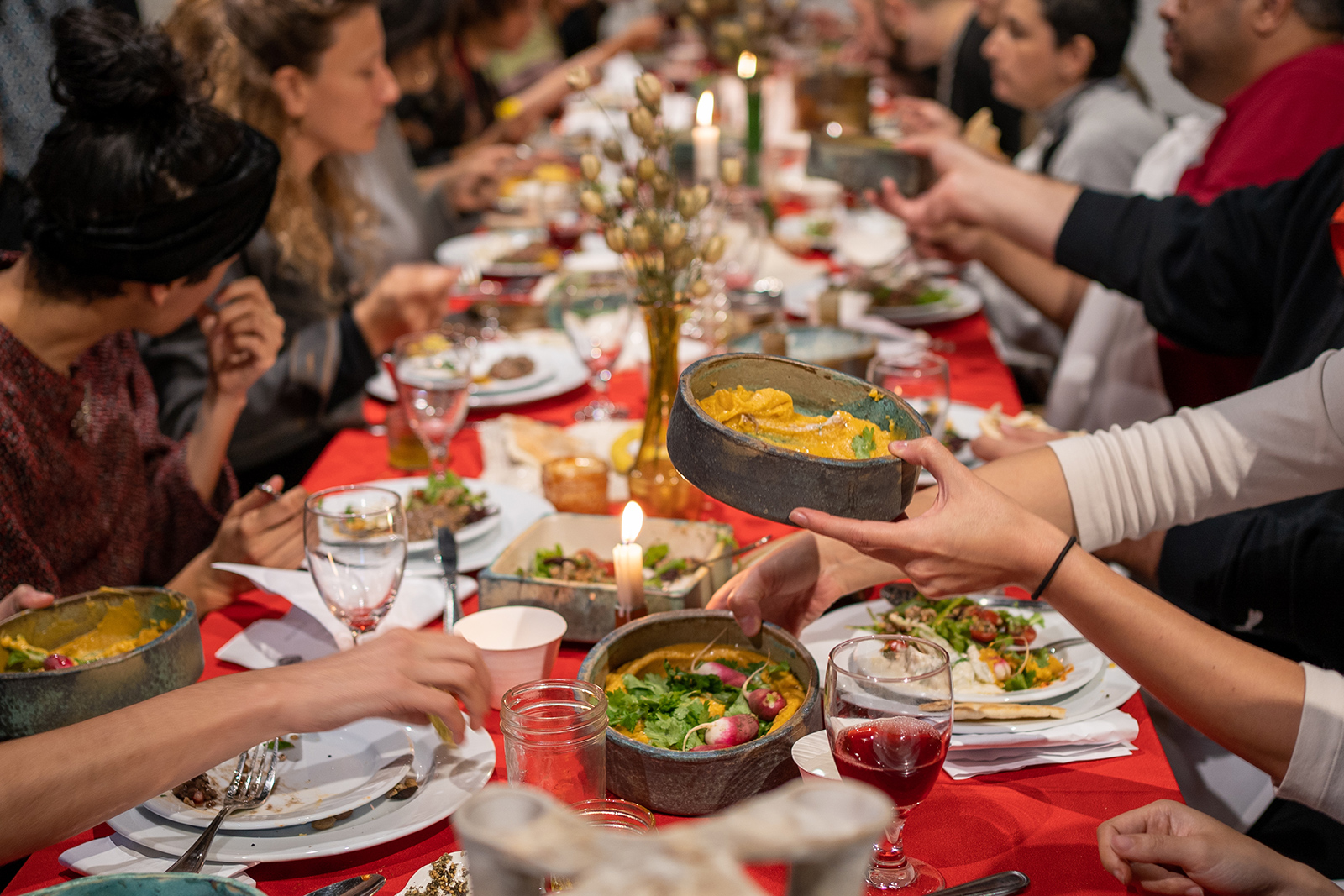
The tongue tracing the hand, tracing the earth, dinner performance, MoMA PS1, NYC, 2021. Photo by Emy Pekal.
Could you speak to how the project has shifted, and how your work grapples with the current moment?
The project has evolved in rhythm with my life. When I was in Palestine, it was rooted in fieldwork, community-based engagements, and live gatherings. I spent time in kitchens, villages, and markets, researching, listening, cooking with elders, tracing stories across regions. But after I was forced to leave in November 2024 because of the war, the entire ground of the work shifted, literally and metaphorically.
The dislocation meant I could no longer access the land, people, and spaces that had shaped the Palestine Hosting Society. The work became more fragmentary, more internal. I began developing installations like Sour Things: Kitchen, Sour Things: The Pantry, Bitter Things: in the name of an orange, and Grieving in Colours, works that emerged from grief, from rupture, from being severed from home. These pieces still carry the ethos of Palestine Hosting Society, but they are no longer about documentation. They are about living through absence.
Sour Things: The Pantry, for instance, became a conceptual and emotional space, an imagined room of preservation in exile. What does preservation look like when you are in-between places? What happens to fermentation when your jars travel with you? What can you preserve when you no longer have access to the seasonality, the crops, or the community you once depended on?
So the project now holds grief differently, it still preserves, but it also mourns. It looks at how knowledge migrates, how it’s held in diaspora, how it adapts or strains under pressure. The urgency is still there, but it has taken on a different texture; quieter, slower, perhaps more raw.

Sour Things: The Pantry, multimedia installation, Noordbrabants Museum, Netherlands, 2024. Photo by Jan-Kees Steenman.
There are important links between people, food cultures, seeds, and food that are often overlooked. Why is it important that we understand settler colonialism and genocide alongside ecocide?
In a settler colonial system, violence doesn’t only target human bodies, it targets systems of life. It erases entire ecosystems and the networks of knowledge, labor, and care they sustain. In Palestine, this is painfully visible: foraging is criminalized, land access is restricted, water is controlled, and agricultural practices that once defined our landscape are systematically dismantled.
Ecocide and genocide are intertwined. They share a goal, to sever the connection between people and place. Destroying native seeds, outlawing wild herbs like akkoub or za’atar, cutting down olive trees, or replacing indigenous agricultural systems with monoculture plantations, these aren’t just environmental acts. They are attacks on cultural survival. On memory. On belonging.
Food traditions are multispecies archives. A dish contains not only human labor and memory, but the migration of seeds, the behavior of bacteria, the rhythms of a harvest. These entanglements are often overlooked because we are conditioned to see food as product, not process, as nourishment, not narrative.
In my work, I try to restore that relationality. Fermentation, for example, becomes a metaphor for interdependence and slowness. A fermented jar is a living community. It’s what happens when human hands collaborate with microbes, with time, with decay. It’s a politics of care, one that resists the extractive, fast-paced logic of settler time. And in this way, food becomes a quiet refusal, a refusal to forget, to assimilate, or to let go.

Khubezeh: A photograph collected during the reseach with the Beduins of Palestine showing a family posing in the middle of a Khubezeh (mallow) field, an edible plant beloved by Palestinians, Jerusalem, 2021. Photo by the artist.
Food practices and tables speak to different forms of hosting and forms of artistic practice. What is the importance of tables, walks, and gatherings as an artistic practice? How do these practices move against disappearance?
Tables, walks, and gatherings are forms of resistance. They allow for slowness, for attentiveness, for presence. In a political condition that is defined by fragmentation and erasure, the act of coming together, of eating together, is radical. It rebuilds what has been broken.
When I create a dinner performance, I’m not simply sharing food. I’m curating an experience where memory becomes tangible, where a story is tasted, where a silence is held collectively, where a forgotten dish is given back to the people. These are not performances in the traditional sense. They are rituals. They are invitations to remember, to feel, to ask questions.
Walks, too, have become an integral part of my practice. Walking through the Old City of Jerusalem, or through abandoned souqs, I guide people not just through space, but through layers of history. These are embodied archives, ways of activating memory through movement, through breath, through proximity.
These practices are anti-monumental. They do not try to fix memory in stone. Instead, they circulate it. They make it relational, alive. And in that circulation, they resist disappearance.

Photograph from the tour: food walks in the Old City of Jerusalem. Photo by Claire Bastier.
What is the role of live/public performance in your work? How would you describe the practice of live arts? How might we understand these practices as makeshift archive?
Live art is the heart of my practice. For me, it is about presence as resistance. It is where everything comes together, the body, the voice, the gesture, the memory, the table, the story, the flavor. It is not static. It cannot be contained in an object. It only exists in the encounter, in the moment of being with others.
I see live art not as a performance to be watched, but as a situation to be entered. It invites vulnerability. It demands attention. In Potato Talks, for example, the audience becomes a participant. A person sits, peels a potato, listens to a story from a stranger across from them. There’s no stage. Just shared time. Shared space. Shared breath. The performance is not in the spectacle, it is in the slowness, the intimacy, the act of peeling and listening.
I think of these live encounters as fugitive archives. They’re not inscribed in books, but in bodies. In taste memory. In emotional residue. In the kind of remembering that happens when you smell something familiar, or when a gesture takes you back to your grandmother’s kitchen.
In contexts like Palestine, where institutional archives are often inaccessible, censored, or destroyed, these ephemeral forms of archiving are essential. They are soft, but they hold. They carry. They transmit. And in their very impermanence, they resist the logic of erasure.

Potato Talk: (Up)rooting, Ramallah Edition, 2016, Qalandiya International. Photo by Nurin Qaoud
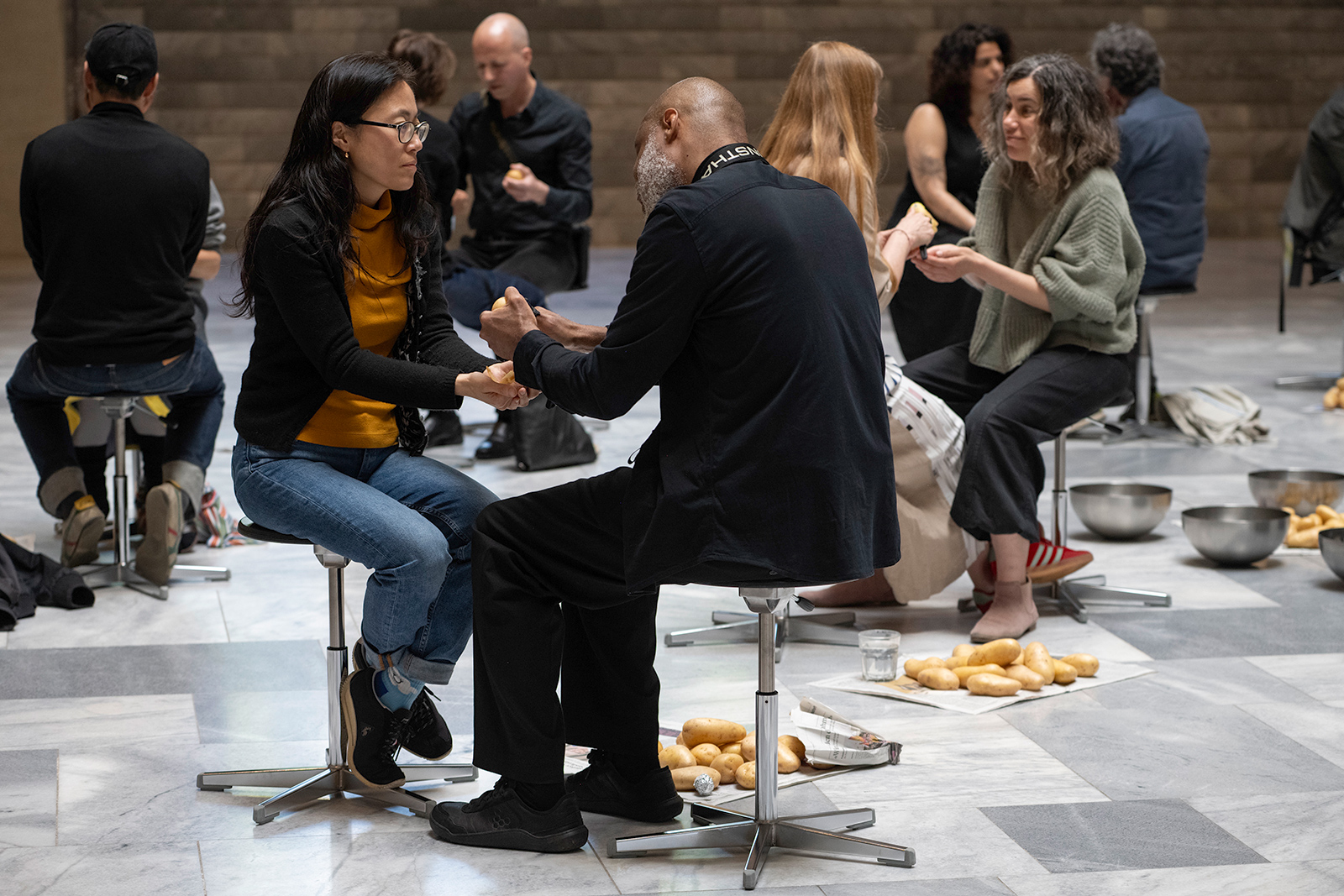
Potato Talks: All the ways we shield, all the ways we reveal, live-art performance, Kunsthaus Zurich, 2025. Photo by Caroline Minjolle.